
← Back to the Nirvana Garden Trail
You found the Date Palm — the large, symmetrical palm anchoring the central garden near the palapa.
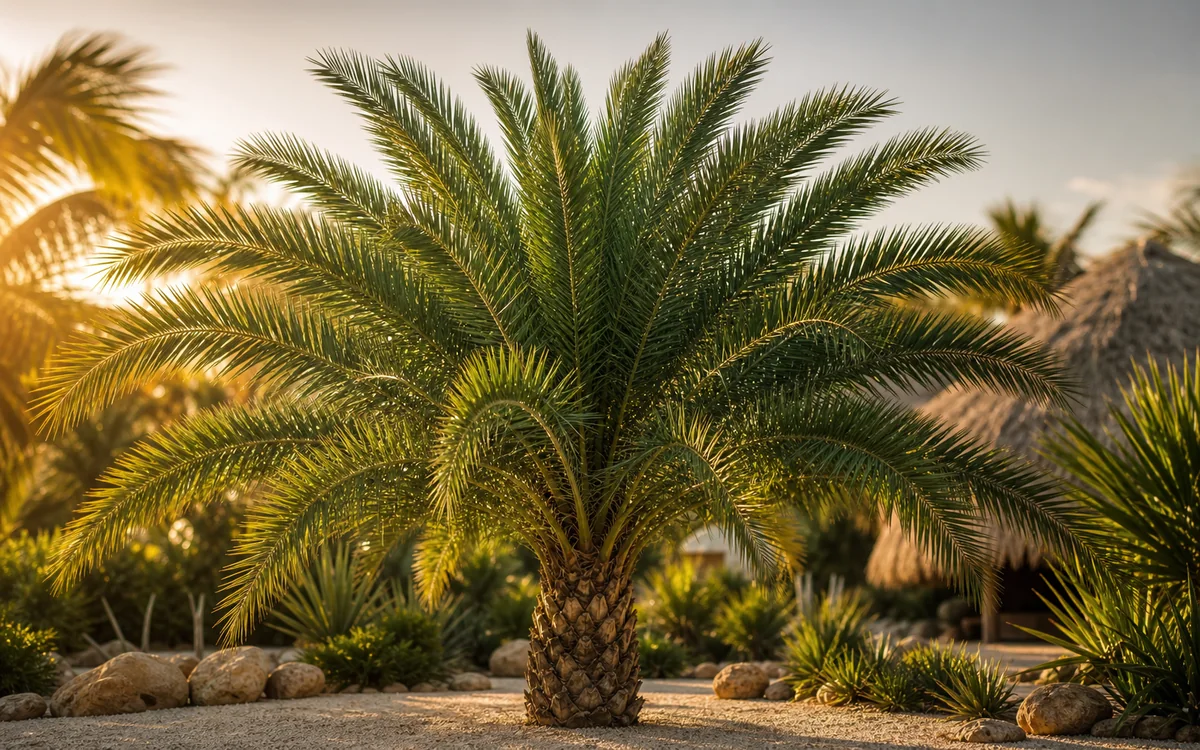
Date Palm at a glance
- Botanical group: Phoenix
- Plant type: Solitary feather palm
- Signature feature: Dense, architectural crown of arching leaves
- Best conditions: Sun, warmth and well-drained soil
- Garden location: Central sandy garden beside the palapa
- Identification note: The exact Phoenix species has not yet been confirmed
The centrepiece of the sandy garden
Seen most clearly from above, the mature Date Palm forms a near-perfect green rosette between the villa and the palapa. Its strong shape acts as a visual anchor while the canopy adds height and filtered shade to the open sandy area.
How to recognise a Date Palm
Date Palms belong to the genus Phoenix. They have feather-like leaves made up of many narrow leaflets, arranged along a central stem. The lower part of each leaf can be armed with sharp spines, so visitors should admire the crown from a comfortable distance.
Made for sun and warmth
Palms in the Phoenix group are widely planted in warm, sunny landscapes. Once established, many cope well with dry conditions, but good drainage and appropriate watering remain important. Their durable foliage and formal shape make them popular as specimen trees.
Why the label stays general
Several Date Palm species can look similar in photographs. Until flowers, fruit, trunk details and close-up leaf features have been checked, this garden guide uses the accurate group name rather than claiming a species that may be wrong.
Find the next plant
Continue towards the outdoor bar to find the Columnar Cactus, or return to the illustrated Nirvana Garden Trail map.